The air a library
All the Light We Cannot SeeThe air a library is the novel’s image of an invisible archive: a medium through which signals, words, memories, and perhaps the presence of the dead continue to travel. It emerges in Marie-Laure LeBlanc’s later life as she imagines the electromagnetic traffic around her, then links that contemporary abundance to the voices and losses that war has left behind. The metaphor does not make memory complete or easy to retrieve. Its library holds every life and sentence, but the people who remain must still endure silence, reluctance, and forgetting.
The Image and Its Occasion
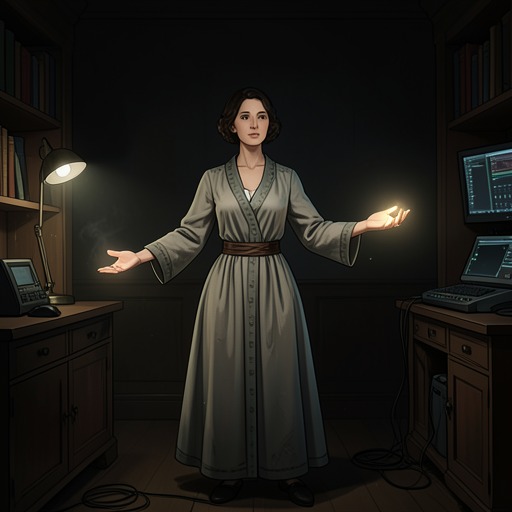
Walking through the gardens with Michel, Marie-Laure listens to the wind in the hedges and the creaking cedars near the maze. She imagines electromagnetic waves entering and leaving Michel’s machine, bending around them as Etienne LeBlanc had once described. The air above Paris, she thinks, now carries vastly more traffic than it did in his lifetime: conversations, television, email, advertisements, and practical messages crossing the city through transmitters, antennas, wires, and fiber networks.
The inventory moves between the enormous and the ordinary. Messages travel over battlefields and national borders, but among them are reminders to make reservations, buy avocados, or ask what someone said. Declarations of love and hate share the same invisible routes as market updates and appointment reminders. The image of a library grows from this mingling: the air is not an empty space between speakers, but a medium thick with communication, much of it unseen by those whose lives it surrounds.
From Signals to the Dead
Marie-Laure extends the image beyond devices. If electromagnetic waves can travel unseen through buildings and across cities, she imagines that the souls of her father, Etienne LeBlanc, Madame Manec, and Werner Pfennig might also move through the air. The thought remains speculative, not a demonstrated fact within the story. Its force comes from the analogy: invisible transmission offers a way to imagine continued presence without claiming that loss has been undone.
The image’s scale shifts from the individual to the collective. The imagined souls pass through streets and bodies, while the air becomes a record of every life lived and every sentence spoken, with transmitted words still reverberating within it. The record is not described as a stable document that anyone can simply open. Rather, it is an accumulation dispersed through the same space people inhabit, a storehouse whose contents may be faint, inaccessible, or audible only in imagination.
Silence, Memory, and What Cannot Be Recovered
The metaphor acquires its emotional weight from the novel’s scenes of failed contact. On the twentieth morning without news of Daniel LeBlanc, Marie-Laure does not get out of bed. She stops asking Madame Manec to take her to the station, write another letter, or return to the prefecture to petition the occupation authorities. She hardly eats, withdraws from ordinary routines, and jerks away when Madame Manec tries to kiss her forehead. The museum has said it is searching, but its reply to Etienne’s appeals brings no resolution: Daniel never arrived. In the face of this absence, the mind supplies imagined sounds of her father’s shoes, keys, and tools; the house’s groaning and the sea’s foam then expose those impressions as deceits rather than messages from him.
Jutta’s memories of Werner show a different form of silence. After receiving two letters announcing his death, each naming a different French burial place, she dreams of standing with him over gears, belts, and motors while he says he is making something. Years later, she whispers his name aloud. Yet she has learned to lock away memories of her brother, and at work in 1974 she does not bring up his attendance at Schulpforta. The library image therefore does not mean that the past is continually available to the people who lived it. Memory may be sealed away even while the story imagines that nothing spoken has entirely vanished.
Letters make that gap between preservation and access concrete. Jutta initially does not want to take the letter that Volkheimer has brought, along with another letter enclosed inside it. In another postwar household, Frederick’s mother receives an envelope whose long passage can be traced from Werner’s brother to an American prisoner-of-war camp in France, a military storage facility in New Jersey, a veterans’ organization in West Berlin, a former sergeant, and finally the woman who writes to her. She recognizes Werner as Frederick’s small, shy friend, but Frederick shows no interest in the old envelope bearing his name. The surviving message reaches its destination; it cannot compel its recipient to receive it inwardly.
Historical Afterlife
The air-as-library image gathers these distinct forms of transmission without pretending they are identical. A signal crosses distance by technology; a letter survives by passing through hands and institutions; a memory returns as a dream or a name spoken aloud. Each depends on some route through time, and each can be interrupted, misheard, withheld, or refused. The contrast between the immense traffic above Paris and the private difficulty of opening one envelope makes abundance no guarantee of understanding.
Marie-Laure’s thought that every hour someone for whom the war is only a memory falls out of the world places the image against generational loss. The record may persist in air, stories, songs, and objects, but the people who can connect those traces to lived experience are disappearing. The novel’s closing movement answers that disappearance not with a promise that the dead return unchanged, but with a more tentative recurrence: life rises again in grass, flowers, and songs. In that ending, the library is both archive and passage—an image for what continues to circulate, and for how much must still be carried by those who remain.